
18+ only. LEON199 is an independent comparison site, not a bookmaker, and not affiliated with Leon or any casino. Gambling support: 1800 858 858
Betting guides · Racing
The four exotic bets on every Australian race card, explained in plain English with worked examples, cost tables and the maths behind boxed and flexi bets.
Updated 6 November 2026 · 12 min read · By the LEON199 editorial team · 18+ only
The basics
A standard win bet asks you to pick one horse to finish first. An exotic bet asks you to pick two, three or four runners, and usually the order they finish in. Because that is much harder, exotics can pay far more than a win bet on any single runner.
In Australia most exotics are tote (pool) bets. Everyone’s stakes go into one pool, the operator takes its commission, and what is left is shared among the winning tickets. That means you won’t know the exact payout until the race is declared. Some licensed bookmakers also offer fixed-odds or “best tote” versions, so always check which product you are using.
Tote dividends are quoted for a $1 unit. If the trifecta pays $250.40 and you had a full $1 unit on the winning combination, you collect $250.40.
| Bet | You pick | Order matters? | Difficulty |
|---|---|---|---|
| Quinella | 2 runners to fill 1st and 2nd | No | Easiest exotic |
| Exacta | 2 runners for 1st and 2nd | Yes | Harder |
| Trifecta | 3 runners for 1st, 2nd and 3rd | Yes | Hard |
| First Four | 4 runners for 1st to 4th | Yes | Hardest |
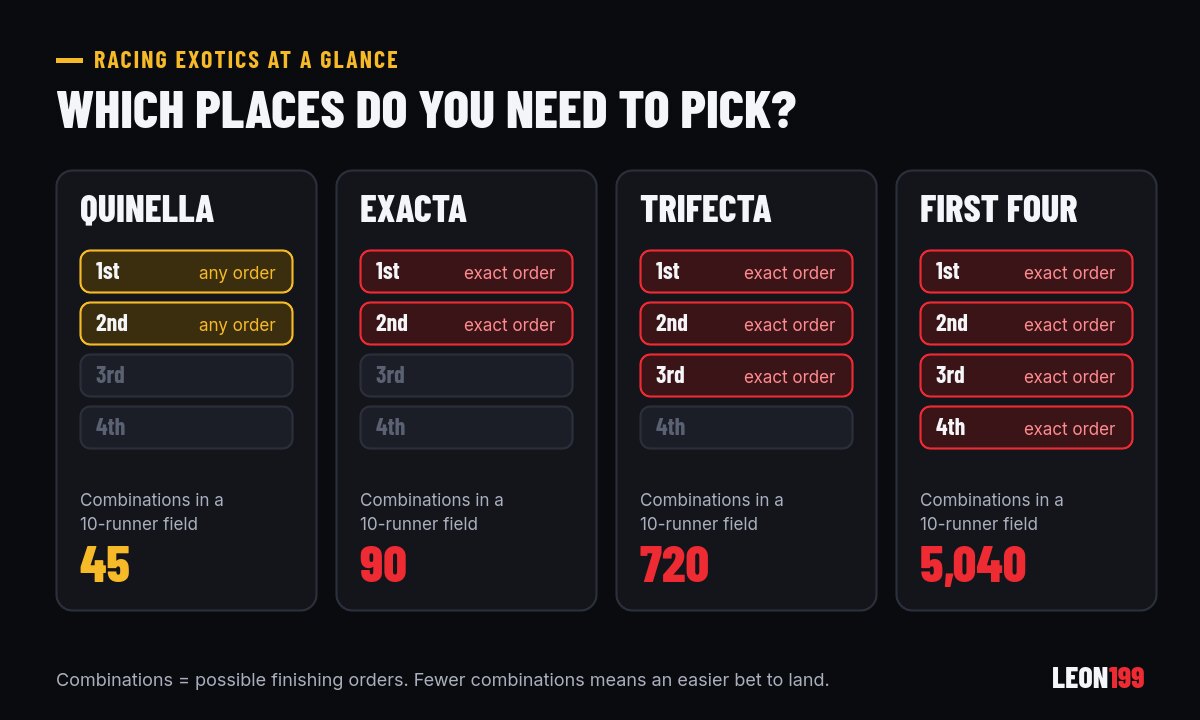
Quinella
A quinella wins if your two runners finish first and second, whichever way round. It is the friendliest exotic for beginners, because you only need two horses to run well, not to finish in a set order.
You take a $10 quinella on runners 3 and 7.
If the quinella dividend is $14.60, your $10 returns $146.00 (10 units × $14.60).
A quinella with two runners is one combination. Add more runners and you “box” them: every pair among your runners is covered. The number of combinations is n × (n − 1) ÷ 2, where n is the number of runners.
| Runners boxed | Combinations | Cost for a full $1 unit |
|---|---|---|
| 2 | 1 | $1 |
| 3 | 3 | $3 |
| 4 | 6 | $6 |
| 5 | 10 | $10 |
| 6 | 15 | $15 |
Popular pairs pay less. When two favourites run first and second, many people hold that quinella, so the pool is split many ways and the dividend can be small.
Exacta
An exacta also uses two runners, but you must name which one wins and which one runs second. Because the order matters, there are twice as many possible results as a quinella, and the dividend is usually higher.
You take a $5 exacta of 3 then 7.
If the exacta pays $31.20, your $5 returns $156.00.
A boxed exacta covers every order of your runners, so it costs n × (n − 1) combinations: 2 for two runners, 6 for three, 12 for four and 20 for five. A standout exacta fixes one runner in first place and lets several others fill second. For example, 3 to win with 5, 7 or 9 second is three combinations.
A quinella on 3 and 7 and a boxed exacta on 3 and 7 cover exactly the same results. The difference is cost and pool: the boxed exacta is two combinations, so it costs twice as much for the same unit, and it is paid from the exacta pool rather than the quinella pool. Compare the approximate dividends before choosing; neither is better every time.
| Same two runners | Combinations | Cost at $1 units | Paid from |
|---|---|---|---|
| Quinella 3-7 | 1 | $1 | Quinella pool |
| Boxed exacta 3/7 | 2 | $2 | Exacta pool |
| Straight exacta 3 then 7 | 1 | $1 | Exacta pool, one order only |
Trifecta
A trifecta needs the first three runners in the correct order. It is one of the most popular exotics on Australian racing because a modest outlay can return a big dividend, but it is also hard to land.
A straight $1 trifecta of 4, 1, 8 only wins if 4 wins, 1 runs second and 8 runs third. Any other order loses.
Boxing your runners covers every finishing order among them. The number of combinations is n × (n − 1) × (n − 2).
| Runners boxed | Combinations | Cost at 100% ($1 units) | Cost at 50% flexi |
|---|---|---|---|
| 3 | 6 | $6 | $3 |
| 4 | 24 | $24 | $12 |
| 5 | 60 | $60 | $30 |
| 6 | 120 | $120 | $60 |
| 7 | 210 | $210 | $105 |
You don’t have to box. A standout trifecta lets you choose different runners for each place, such as 1 to win, with 2, 3 or 4 for second and 2, 3 or 4 for third. That is 1 × 3 × 2 = 6 combinations. A roving banker means one runner must finish somewhere in the top three while your other picks fill the remaining places. Both cost less than a full box when you have a strong view on one runner.
First Four
The First Four (sometimes called a superfecta overseas) needs the first four runners in the exact order. Dividends can run into the thousands because so few tickets win.
Combinations grow very fast, so most people bet the First Four on flexi rather than full units.
| Runners boxed | Combinations | Cost at 100% | Flexi on a $20 outlay |
|---|---|---|---|
| 4 | 24 | $24 | 83.3% |
| 5 | 120 | $120 | 16.7% |
| 6 | 360 | $360 | 5.6% |
| 7 | 840 | $840 | 2.4% |
| 8 | 1,680 | $1,680 | 1.2% |
You box 6 runners in a First Four for $20. That is 360 combinations, so your flexi is $20 ÷ 360 = 5.56%. If the First Four dividend is $1,800, you collect $1,800 × 5.56% = $100.
Flexi betting
Flexi lets you decide how much to spend and then works out what share of each combination you hold. The formula is:
Flexi % = your stake ÷ number of combinations × 100
If one of your combinations wins, you collect that percentage of the $1 dividend. Flexi doesn’t change your chance of winning; it changes how much you spend and how much you collect.
| Bet | Combinations | Your stake | Flexi | Example dividend | You collect |
|---|---|---|---|---|---|
| Boxed quinella, 4 runners | 6 | $6 | 100% | $18.40 | $18.40 |
| Boxed exacta, 3 runners | 6 | $3 | 50% | $42.60 | $21.30 |
| Boxed trifecta, 4 runners | 24 | $12 | 50% | $310.00 | $155.00 |
| Boxed First Four, 6 runners | 360 | $20 | 5.56% | $1,800.00 | $100.00 |
Dividends in the table are examples for illustration, not real results. Operators set their own minimum flexi percentage, so check before you bet.
Compare
Each extra place you need to get right makes the bet far harder. Here is how many possible results there are in two common field sizes.
| Bet | Runners you pick | Order matters? | Results in a 10-runner field | Results in a 14-runner field |
|---|---|---|---|---|
| Quinella | 2 | No | 45 | 91 |
| Exacta | 2 | Yes | 90 | 182 |
| Trifecta | 3 | Yes | 720 | 2,184 |
| First Four | 4 | Yes | 5,040 | 24,024 |
The fine print
Every tote and bookmaker publishes its own rules, and they differ. These are the situations to check before you bet:
| Situation | What usually happens | What to check |
|---|---|---|
| A runner in your bet is scratched | Combinations that include the scratched runner are usually refunded. The rest of your bet stands. | Whether the operator substitutes another runner instead. |
| Dead heat for a place | Dividends are declared for each valid combination, so each one is usually smaller. | How the operator splits pools in a dead heat. |
| Protest or inquiry | Bets are settled on the official result, once the race is declared. | Whether early payouts apply. |
| Nobody picks the winning combination | The pool may jackpot to a later race. | Which races carry jackpots. |
Only bet with operators licensed in Australia. You can check any bookmaker against our licensed bookmakers list.
Keep it fun
In a 10-runner field there are 5,040 possible First Four results. Even with good form study, exotics have a low strike rate, so long losing runs are normal.
FAQs
Both use two runners. A quinella wins if they finish first and second in either order. An exacta only wins if they finish in the exact order you picked.
A boxed trifecta covers every finishing order of the runners you choose. With 3 runners that is 6 combinations; with 4 runners it is 24.
At full $1 units, a 3-runner box costs $6, a 4-runner box $24 and a 5-runner box $60. With flexi you can spend less and collect a matching share of the dividend.
Flexi is your stake divided by the number of combinations, shown as a percentage. If you spend $12 on a 24-combination trifecta, your flexi is 50% and you collect half the dividend if you win.
Neither is better every time. A quinella is easier to win; an exacta usually pays more. A boxed exacta covers the same results as a quinella but costs twice as much and is paid from a different pool.
With most Australian operators, the combinations that include the scratched runner are refunded and the rest of the bet stands. Rules vary, so check your operator’s terms.
A quaddie is a different exotic: you pick the winners of four nominated races. It is not the same as a First Four, which is about the first four places in one race.
Written by the LEON199 editorial team. Combination counts use standard permutation formulas, and every dividend in this guide is an example, not a real result. LEON199 doesn’t take bets, and no bookmaker paid for or reviewed this guide.
Sources: ACMA online gambling, Gambling Help Online, BetStop.
Safer gambling
Gambling should never be a way to make money or solve money problems. Set a deposit limit before you bet, and if gambling stops being fun, talk to someone. Free, confidential support is available 24/7.