
18+ only. LEON199 is an independent comparison site, not a bookmaker, and not affiliated with Leon or any casino. Gambling support: 1800 858 858
Betting guides · Sports
How multi odds are calculated, how Same Game Multis differ, what happens when a leg is void, and the maths that explains why most multis lose.
Updated 6 November 2026 · 11 min read · By the LEON199 editorial team · 18+ only
The basics
A multi (also called a multibet, parlay or accumulator) joins two or more separate bets into one ticket. Each bet is called a leg. If every leg wins, you are paid at the combined odds. If any single leg loses, the whole multi loses, even if every other leg came in.
Multis are popular in Australia because a small stake can return a large amount. That bigger payout exists for a reason: the more legs you add, the less likely it is that all of them win.
| Term | What it means |
|---|---|
| Leg | One selection inside the multi, such as a team to win |
| Combined odds | All the leg odds multiplied together |
| Void leg | A leg that is cancelled, for example because a match is abandoned |
| Same Game Multi (SGM) | A multi where every leg comes from the same match |
| Cross-game multi | A standard multi with legs from different matches or sports |
The calculation
Australian bookmakers use decimal odds, which include your stake. To get the multi odds, multiply the odds of every leg. To get your return, multiply your stake by the multi odds.
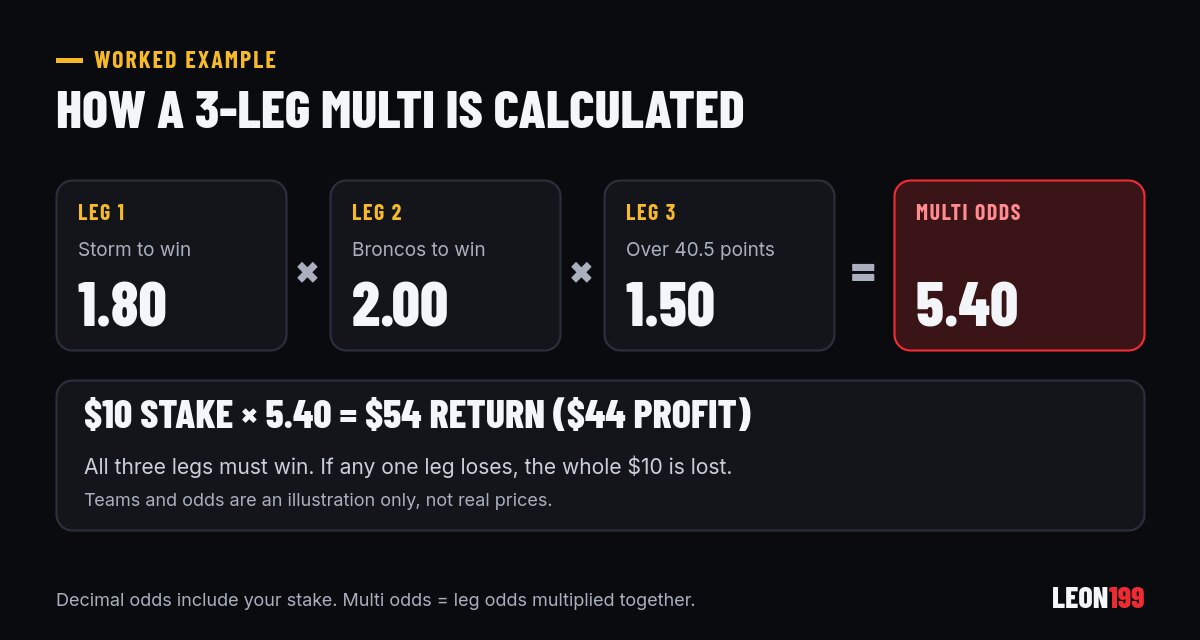
Three legs at 1.80, 2.00 and 1.50:
This table assumes every leg is priced at 1.90, a typical price for an even-money market such as a line or total.
| Legs | Multi odds | $10 returns |
|---|---|---|
| 1 | 1.90 | $19.00 |
| 2 | 3.61 | $36.10 |
| 3 | 6.86 | $68.59 |
| 4 | 13.03 | $130.32 |
| 5 | 24.76 | $247.61 |
| 6 | 47.05 | $470.46 |
Same Game Multi
A Same Game Multi (SGM) builds a multi from several markets in one match. In the AFL that might be a team to win, a player to get 20+ disposals and total points over a line. In the NRL it might be a team to win and a player to score a try.
The catch is that these outcomes are linked. If a team wins comfortably, its star players are more likely to have big games and the line is more likely to be covered. Because the legs are connected, the bookmaker doesn’t simply multiply the prices. It prices the whole package, and the SGM price is usually lower than the leg odds multiplied together.
An AFL Same Game Multi with three legs:
Multiplied together these are 5.62. Because a Team A win makes the other two legs more likely, a bookmaker might offer the SGM at around 4.20 instead. Prices vary between bookmakers and change up to the start.
Bookmakers also tend to build a bigger margin into Same Game Multis than into single bets, so comparing the SGM price with the single prices is worth doing before you bet.
Compare
| Standard multi | Same Game Multi | |
|---|---|---|
| Legs come from | Different matches, races or sports | One match only |
| How odds are worked out | Leg odds multiplied | Priced by the bookmaker as a package |
| Are the legs linked? | Usually independent | Often strongly linked |
| Typical bookmaker margin | Margin on each leg, compounded | Usually higher than singles |
| Common markets | Head to head, line, totals, racing | Player stats, tryscorers, margins, totals |
| Online in Australia | Before the event starts | Before the match starts |
Under the Interactive Gambling Act 2001, licensed bookmakers can’t take sports bets online or in an app once a match has started. Live bets are only allowed by phone. A site offering in-play multis online is not licensed in Australia.
The maths
Every leg you add has to win too, so your chance of landing the multi is all the leg chances multiplied together. With 50/50 legs, each extra leg halves your chance.
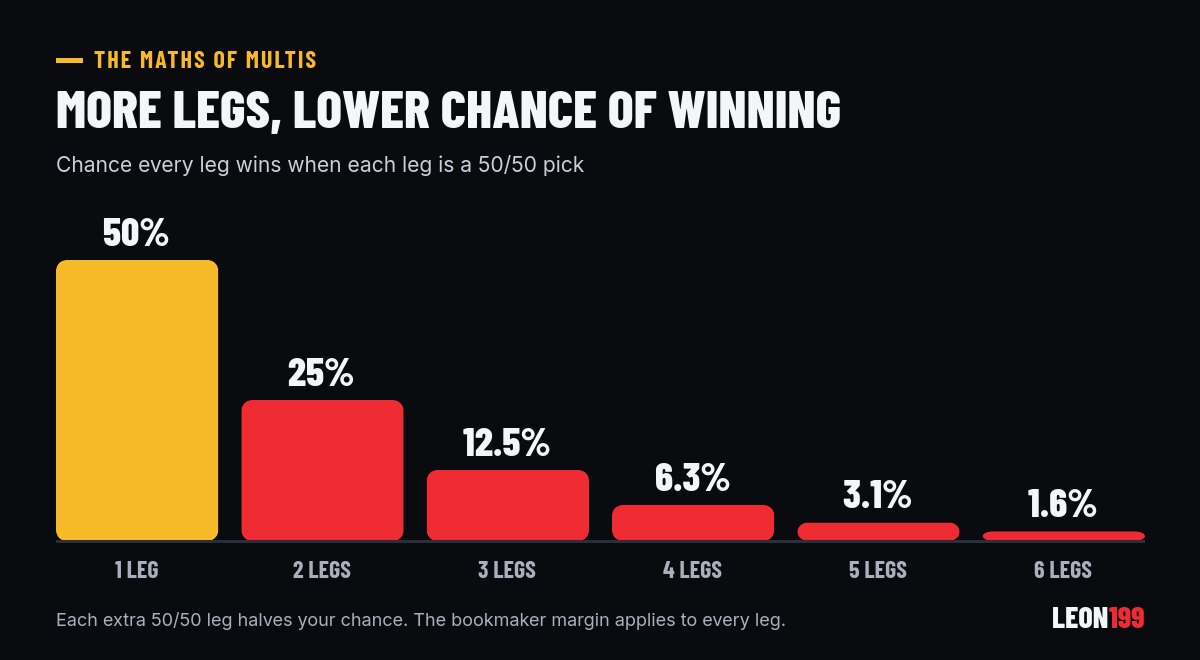
Bookmakers build a margin into every price. On a true 50/50 market they might offer 1.90 instead of 2.00. On a single bet that margin costs you about 5% over time. In a multi it applies to every leg, so it grows with each one you add.
| Legs at 1.90 | True chance (50/50 legs) | Multi odds | Long-run return per $100 staked |
|---|---|---|---|
| 1 | 50% | 1.90 | $95.00 |
| 2 | 25% | 3.61 | $90.25 |
| 3 | 12.5% | 6.86 | $85.74 |
| 4 | 6.25% | 13.03 | $81.45 |
| 5 | 3.13% | 24.76 | $77.38 |
| 6 | 1.56% | 47.05 | $73.51 |
The last column is the average you would get back over a very large number of bets, not what happens on any single ticket. It shows why a long multi is a low-probability, high-margin bet, best treated as entertainment with money you can afford to lose.
The fine print
| Situation | What usually happens | Example |
|---|---|---|
| A match is abandoned or a runner is scratched | The leg is made void. The multi continues with the remaining legs at lower odds. | A void 2.00 leg turns 5.40 into 1.80 × 1.50 = 2.70. $10 now returns $27. |
| A dead heat in one leg | That leg is settled at reduced odds, which lowers the whole multi. | A 3.00 leg in a two-way dead heat usually counts at half the stake, which halves the return from that leg. |
| A player in an SGM doesn’t take the field | Rules differ. Some bookmakers void the leg, others void the whole SGM. | Read the SGM rules before you bet. |
| You cash out early | The bookmaker offers a price to settle now. That price includes its margin. | Cash out locks in less than the full return if every leg went on to win. |
Every licensed bookmaker publishes its own settlement rules. When a multi includes racing, scratchings and deductions can also change the final odds.
Promotions
Some licensed bookmakers run multi offers, such as an odds boost on a multi or a bonus bet back if only one leg fails. These can add value, but the conditions matter:
A promotion doesn’t change the maths above. A longer multi is still less likely to win.
Keep it fun
A six-leg multi at 47.05 returns $470 from $10, but with 50/50 legs it wins about 1.6% of the time. That is roughly once in every 64 tickets.
FAQs
A multi combines two or more bets into one. Every leg has to win for the multi to pay, and the odds of each leg are multiplied together.
Multiply the decimal odds of each leg. Legs at 1.80, 2.00 and 1.50 make 5.40, so a $10 multi returns $54.
A Same Game Multi is a multi where all legs come from one match, such as a team to win plus a player to score. The bookmaker prices it as a package because the legs are linked.
The legs in an SGM are connected. If one happens, the others become more likely, so the bookmaker reduces the combined price. SGMs also usually carry a higher margin.
Usually that leg is removed and the multi is settled on the remaining legs at lower odds. Same Game Multi rules vary, so check your bookmaker’s terms.
There is no right number, but each extra leg lowers your chance of winning and adds more margin. Many experienced punters keep multis to two or three legs.
No. Online in-play betting on sport is not allowed in Australia. You can bet a multi before the first event starts, or place live bets by phone with a licensed bookmaker.
Written by the LEON199 editorial team. Odds, teams and players in the examples are illustrations, not real prices. Long-run returns assume 50/50 legs priced at 1.90. LEON199 doesn’t take bets, and no bookmaker paid for or reviewed this guide.
Sources: ACMA online gambling, Gambling Help Online, BetStop.
Safer gambling
Gambling should never be a way to make money or solve money problems. Set a deposit limit before you bet, and if gambling stops being fun, talk to someone. Free, confidential support is available 24/7.